Why Letting Go of the Past Is Essential for Real Transformation
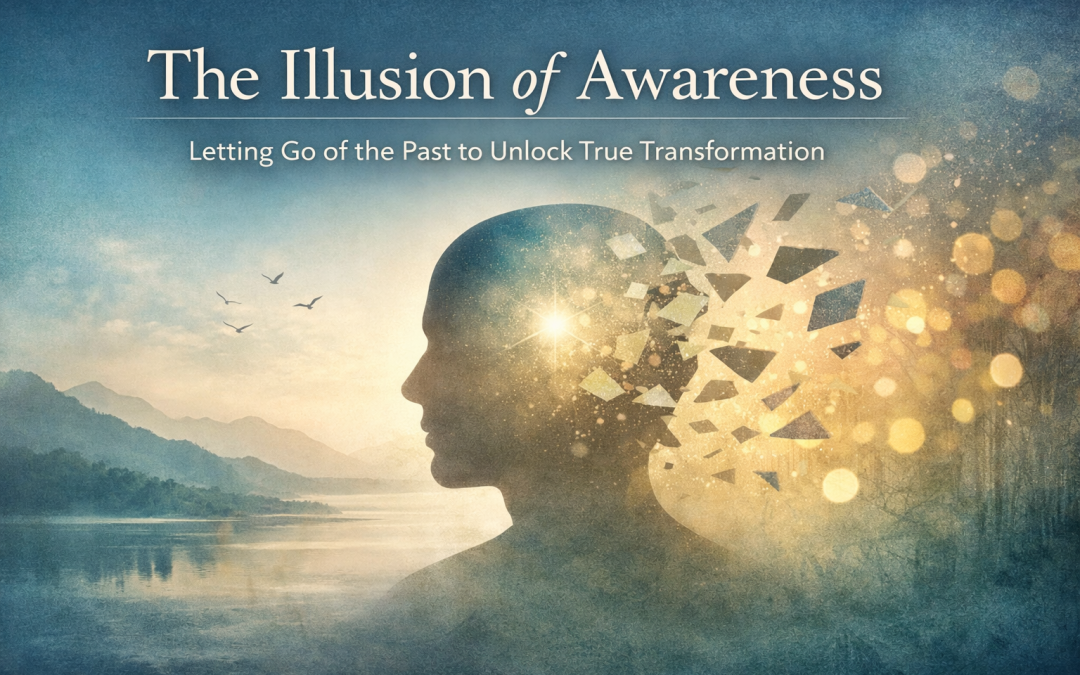
Most of us live as if we’re fully aware — conscious authors of our thoughts, decisions, and memories. It feels obvious: I know what I’m thinking. I know why I act the way I do.
But biology tells a very different story.
The truth is uncomfortable and liberating at the same time: you are aware of far less than you think. And once you truly grasp this, change becomes possible.
You Experience Only a Tiny Slice of Reality
Every second, your senses absorb an overwhelming amount of information — light, sound, touch, smell, internal signals from your body. Yet only a microscopic fraction of that data ever reaches conscious awareness.
Your brain filters relentlessly. Most of what you see, hear, and feel is processed automatically, outside your awareness, and discarded if it’s not immediately relevant to survival or meaning.
What you experience as “reality” is therefore not reality itself, but a simplified, edited version—shaped by past experiences, emotional state, beliefs, and expectations.
This isn’t a flaw. It’s efficiency.
But it also means you’re living inside a highly selective interpretation of life, not the full picture.
Conscious Control Is the Exception, Not the Rule
While we like to believe we’re consciously in charge, most of what drives us — habits, reactions, emotional responses, preferences — runs on autopilot.
Your conscious mind can only handle a few pieces of information at once. Meanwhile, unconscious systems are managing perception, emotion, memory, pattern recognition, and bodily regulation in the background.
This is why you can:
- React emotionally before thinking
- Repeat patterns you’ve “decided” to change
- Feel triggered without knowing why
Your awareness is more like a spotlight than a control center.
Memory Is Not Truth — It’s Reconstruction
If perception is filtered, memory is even less reliable.
Memories are not stored like recordings. Each time you recall the past, your brain reconstructs it — filling gaps, reshaping emotions, and adjusting details to fit the current narrative you hold about yourself and the world.
Over time:
- Details are added or removed
- Emotions intensify or soften
- Meaning changes
What you remember feels real—but it’s often a blend of fact, interpretation, emotion, and imagination.
In other words: the past you’re holding onto may never have existed the way you think it did.
Why Holding Onto the Past Limits You
When you realize how little you consciously perceive, how automatically you react, and how unreliable memory can be, one insight becomes unavoidable:
Basing your identity, limits, or future on the past is deeply flawed.
Many beliefs that define you —
- “This is who I am”
- “This always happens to me”
- “I can’t change because of what happened”
— are built on filtered perceptions and reconstructed memories.
Holding onto them keeps your nervous system locked in old patterns, even when the original conditions no longer exist.
Transformation Begins with Letting Go
Letting go doesn’t mean denying your experiences.
It means loosening their grip on your present.
When you question the certainty of your perceptions and memories, space opens:
- Space to respond instead of react
- Space to feel without being overwhelmed
- Space to choose differently
Practices that increase awareness — such as mindfulness, somatic work, and gentle inquiry — help bring unconscious patterns into view, where they can soften and release.
You don’t transform by fixing the past.
You transform by no longer living inside it.
Beyond the Illusion
You are not your automatic reactions.
You are not your edited memories.
You are not limited by what your awareness once missed.
True optimization begins when you stop assuming you’re fully aware — and start working with the deeper intelligence beneath the surface.
Optimized Being exists to guide that shift.
Because your greatest potential lies beyond the illusion of control — and beyond the past you think defines you.