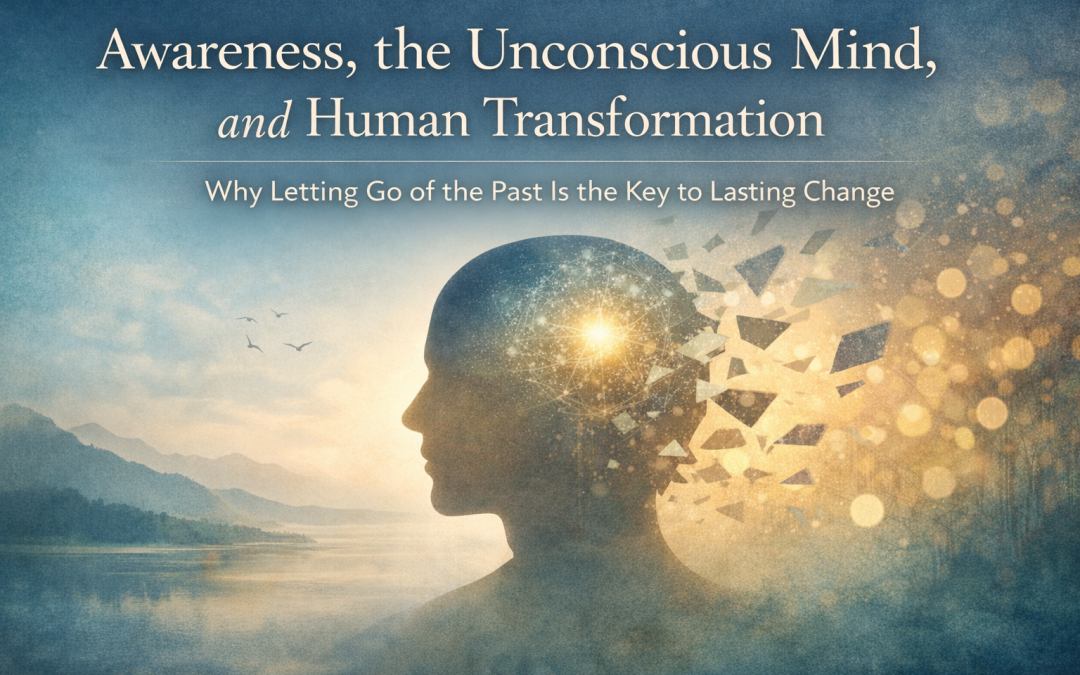
Why Letting Go of the Past Is the Key to Lasting Change
Most people approach change with effort.
They try to think differently, act differently, and push themselves into new habits.
And yet, the same patterns return.
This is not because people lack discipline or intelligence.
It’s because real transformation does not begin at the level of conscious thought.
It begins beneath awareness.
This page explores how awareness actually works, why the unconscious mind shapes most of your life, and how lasting transformation becomes possible—not by force, but by letting go of what no longer serves.
Awareness Is Far More Limited Than It Feels
It feels like you are fully present in your life—seeing clearly, choosing freely, and acting deliberately.
Biologically, this isn’t true.
Your senses take in an enormous amount of information every second. Yet only a tiny fraction ever reaches conscious awareness. The rest is filtered automatically by the brain based on relevance, past experience, emotional state, and survival needs.
What you experience as “reality” is therefore not reality itself—but a highly edited interpretation.
This explains why:
Two people can experience the same event very differently
Emotional reactions arise before conscious thought
Insight alone often fails to create change
Awareness is not a full picture. It is a spotlight.
The Unconscious Mind Runs the Show
While conscious thought feels important, it is only a small part of your internal system.
The unconscious mind governs:
Emotional responses
Habits and behavioural patterns
Perception and interpretation
Memory reconstruction
Nervous system regulation
By the time you “decide” how to respond, much of that response has already been set in motion.
This is why people often say:
“I know better, but I still react”
“I understand it logically, but nothing changes”
“I’ve worked on this before—why is it still here?”
Transformation requires engaging the systems beneath thought, not trying to overpower them.
Memory Is Not the Past — It’s a Reconstruction
One of the strongest forces keeping people stuck is their relationship with the past.
We tend to treat memory as truth—as if it were a recording. In reality, memory is reconstructed each time it is recalled. Emotion, belief, meaning, and imagination all influence what is remembered.
Over time, memories become stories rather than facts.
This means the past you are reacting to may not be what actually happened—but how your nervous system learned to interpret and store it.
When emotional charge remains unresolved, the body continues responding as if the past is still present.
Why Letting Go Feels So Difficult
Letting go is often misunderstood.
It doesn’t mean:
Forgetting what happened
Minimizing pain
Forcing positivity
Letting go feels difficult because it threatens identity. Many beliefs about who you are, how safe the world is, and what to expect are built on past experiences.
From a nervous system perspective, holding on can feel safer than releasing—even when it causes suffering.
True letting go happens when awareness reaches what was previously unconscious, allowing the body and nervous system to update to present reality.
Awareness Is the Gateway to Transformation
Awareness is not about analyzing more.
It’s about perceiving more clearly.
As awareness deepens:
Automatic reactions slow
Emotional patterns soften
The nervous system begins to regulate
Choice becomes possible
Transformation then becomes less about effort and more about release.
You don’t change by fixing yourself.
You change by removing what no longer needs to be carried.
When Emotional Patterns Are Stored in the Body
Many limiting patterns are not held in thoughts—they are held in the body.
Emotional experiences can create long-standing protective responses, especially when they were overwhelming or unresolved. These patterns may persist long after the original situation has passed.
For some people, emotional holding forms what is often described as a heart wall—a protective layer that dampens feeling and connection as a way to stay safe.
Working With Emotional Holding Patterns
When emotional charge remains stored, insight alone may not be enough. The nervous system needs support to release what it has been holding.
A Heart Wall Session offers a gentle way to access and release emotional patterns that may be influencing perception, relationships, and self-expression—often without conscious awareness.
Beyond Insight: Embodied Release and Integration
Understanding patterns is valuable, but transformation happens when the body feels safe enough to let go.
Stress, trauma, and unresolved emotion can keep the nervous system in a state of vigilance. In this state, change feels hard, and awareness alone may not penetrate deeply enough.
Supporting the Nervous System
An Energy Healing Session can support the body’s natural capacity to regulate, release subconscious stress, and integrate awareness at a deeper level.
This is not about forcing change—but about creating the conditions where release can occur naturally.
Transformation Requires Energy — Literally
Personal growth is often framed as psychological or emotional, but it is also biological.
The brain and nervous system require stable energy to:
Regulate emotions
Process awareness
Release stored stress
Maintain resilience
When energy is depleted, transformation feels harder. Patterns feel more rigid. Emotional regulation becomes more difficult.
The Physical Foundation of Change
Optimized nutrition supports:
Nervous system stability
Brain function
Metabolic energy
Emotional resilience
When the body is supported, inner work becomes easier and more sustainable.
A More Intelligent Approach to Change
Lasting transformation does not come from forcing new behaviors on top of old patterns.
It comes from:
Awareness
Nervous system regulation
Emotional release
Physical support
This approach honors the intelligence of the human system rather than fighting it.
Continue Exploring
If this perspective resonates, you may find this helpful:
The Illusion of Awareness – How little we consciously perceive, and why that matters
Awareness-based healing and release practices
The Discovery Report – uncovering unconscious patterns influencing your life
You don’t need to become someone new.
You need to let go of what you are no longer meant to carry.
That is where real transformation begins.